
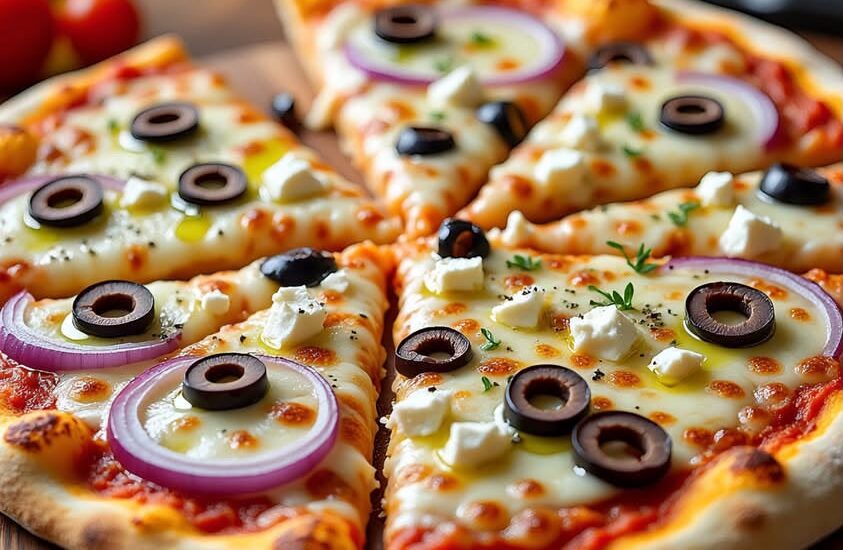
 Posted by
 Craving a Greek pizza twist? Discover how feta, kalamata olives, and red onion transform pizza night into a Mediterranean flavor escape. My first real encounter with it happened at a tiny corner shop that smelled like oregano and burnt olive oil, and I remember standing there thinking, wait, pizza is allowed to taste like this? No heavy tomato sauce drowning everything, no mountain of mozzarella hiding the toppings. Just feta cheese crumbled generously across the top, a scatter of briny kalamata olives, and thin curls of red onion doing exactly what red onion does best, which is complain loudly about its own existence in the best possible way.
Greek pizza has become one of those dishes I keep coming back to here on Pizzapedia, mostly because it refuses to behave like a normal pizza. It borrows its identity from Mediterranean cooking rather than Italian tradition, and honestly, that is part of the charm. Feta olive red onion pizza sits somewhere between a flatbread and a salad that got ambitious, and I mean that as a compliment.
Let me talk about the feta for a second, because feta is doing the heavy lifting here. Real feta, the kind made from sheep milk or a blend of sheep and goat milk, has this tang that mozzarella could never dream of producing. It does not melt the same way either. Mozzarella stretches and pools into gooey ribbons, but feta just sort of softens and gets creamy around the edges while holding its shape in the middle. I once tried substituting a cheaper feta-style cheese from a bargain bin, and my roommate looked at me like I had personally wronged him. Lesson learned. Buy the real feta, the block kind packed in brine, not the pre-crumbled bags that dry out in the fridge.
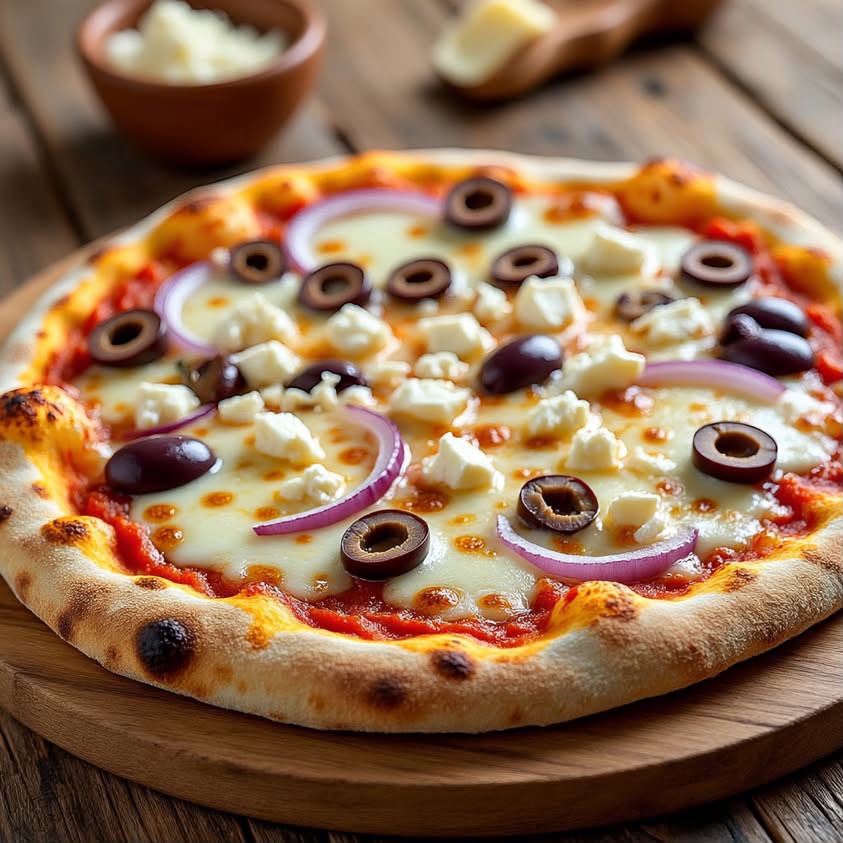
Then there are the olives, and here I have opinions I did not expect to have this strongly. Kalamata olives are the traditional choice for a reason. They are deep purple, almost wine colored, with a fruity bitterness that plays well against the salt of the feta. Some people reach for canned black olives instead, which, look, I am not going to yell at anyone for that, but it changes the whole flavor profile into something flatter and less interesting. If you can find kalamatas pitted and halved, your pizza will thank you. If you cannot, canned olives will still get the job done, just do not expect the same depth.
Red onion is the part people underestimate the most, I think. Sliced thin, it adds a sharp bite that cuts through the richness of the cheese and the olive oil base most Greek pizzas use instead of tomato sauce. Some recipes call for a light drizzle of olive oil and a scattering of dried oregano as the base, which sounds almost too simple to work, yet it works incredibly well. The onion softens slightly in the oven heat but keeps enough crunch to remind you it is there. I like to soak my onion slices in cold water for ten minutes before baking, just to take the edge off that raw onion punch, though plenty of purists would tell me that step is unnecessary.
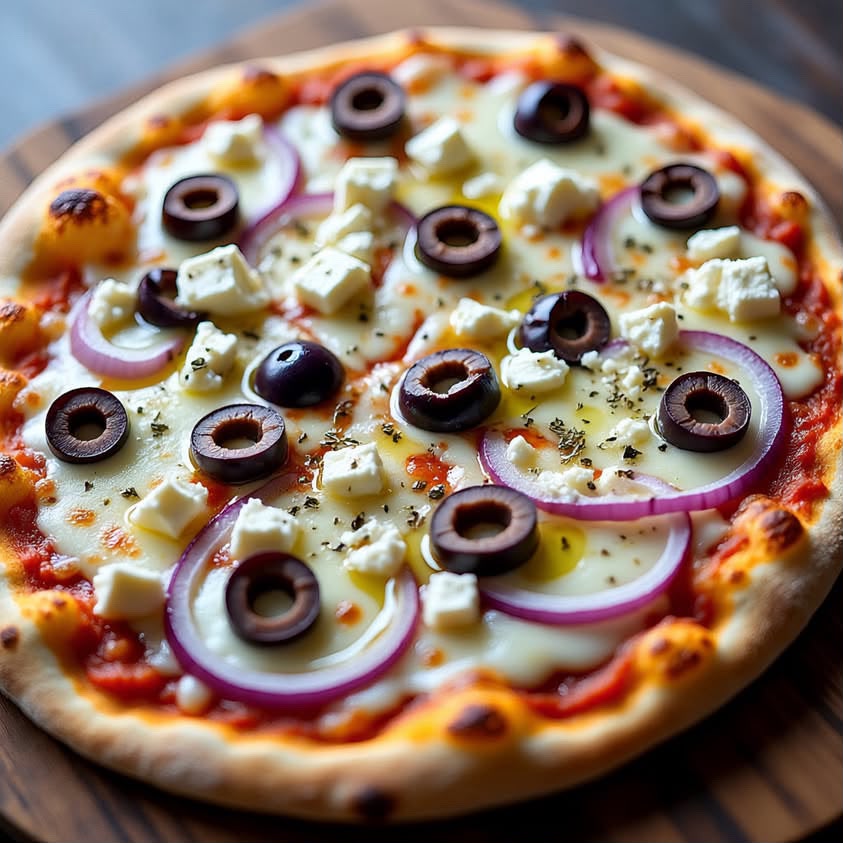
Building this pizza does not require much fuss, which I appreciate on busy weeknights. I start with a thin crust, because Greek pizza tends to lean lighter and crispier rather than doughy and thick. A brush of olive oil goes down first, sometimes with a clove or two of minced garlic mixed in. Then the feta, broken into small chunks rather than crumbled too finely, because you want little pockets of tangy cheese scattered around rather than an even layer. The olives go on next, followed by the red onion, and if I am feeling ambitious I will add a handful of fresh spinach or a few sun-dried tomatoes, though the classic version stays simple with just those three main ingredients.
Baking temperature matters more than people realize. I run my oven as hot as it will go, usually around five hundred degrees Fahrenheit, because a blazing hot oven gives the crust that slight char and keeps the toppings from turning soggy. Ten to twelve minutes is usually enough, though every oven has its own personality and you will need to keep an eye on things the first time you make it.
What strikes me every time I make this pizza is how different it tastes from what most people picture when they hear the word pizza. There is a brightness to it, a saltiness balanced with sharpness, that feels more like summer in a Greek taverna than a Friday night takeout order. Does it replace a classic pepperoni pie? Not for everyone, and that is fine. But for anyone curious about Mediterranean pizza flavors or looking to shake up a predictable pizza night, feta olive red onion pizza deserves a spot in the rotation.
I keep circling back to this recipe because it reminds me that pizza does not have one single definition. It bends toward whatever culture picks it up, and Greek cuisine brought something genuinely worth trying to the table. Give it a shot sometime, maybe with a glass of something cold on a warm evening, and see if it does not change how you think about what a pizza can be.
Reference
U.S. Department of Agriculture, Agricultural Research Service. (2019). Cheese, feta. FoodData Central. https://fdc.nal.usda.gov/food-details/173420/nutrients
Hagidimitriou, M. (2021). Identification and quantification of phenolic compounds in fresh and processed table olives of cv. ‘Kalamata’. Notulae Botanicae Horti Agrobotanici Cluj‑Napoca, 49(2), Article 12394. https://www.notulaebotanicae.ro/index.php/nbha/article/view/12394
Rocchetti, G., Rebecchi, A., Dallolio, M., Braceschi, G., Domenici, M., Trevisan, M., & Lucini, L. (2020). Table olives and health: A review. Journal of Nutritional Science, 9, e57. https://doi.org/10.1017/jns.2020.28