
 Posted by
 Discover how truffle oil on Pizza works and how to use it effectively for the ultimate homemade pizza experience. Few ingredients in the pizza world carry as much mystique as truffle oil. The moment you drizzle it over a freshly baked pie, the aroma alone tells you that something special is happening. I remember the first time I encountered truffle oil on pizza at a small wood-fired restaurant in the Pacific Northwest. The waiter finished the pizza tableside with a thin, golden drizzle, and I sat there thinking, ” Is this the most unnecessarily fancy thing I have ever seen? Turns out, it was the most revelatory pizza I had tasted in years.
Truffle oil is made by infusing a neutral or olive oil base with the flavor compounds found in truffles, those rare and intensely aromatic fungi that grow underground near the roots of oak and hazelnut trees. The real stuff made with actual truffle shavings is genuinely hard to come by and priced accordingly. Most commercial truffle oils on the market today use a synthetic compound called 2,4-dithiapentane, which mimics the characteristic earthy, umami-forward scent of truffles remarkably well. Does it matter which kind you use on your pizza? Honestly, that depends on how deep your wallet goes and how refined your palate is.
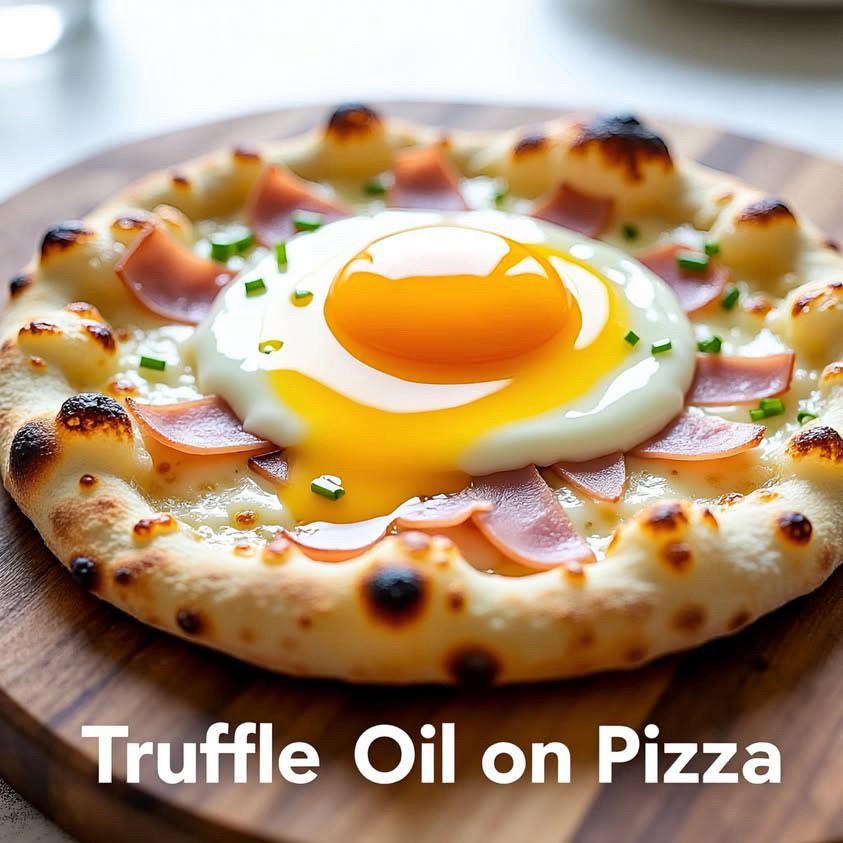
What makes truffle oil such a compelling pizza topping is its ability to amplify everything around it. On a white pizza with ricotta, mozzarella, and roasted garlic, a few drops of truffle oil turn something already delicious into something you genuinely cannot stop thinking about. I have tested this theory more times than I care to admit at home. The oil seems to deepen every flavor it touches; it makes the cheese taste richer, the garlic more complex, and the crust somehow more substantial. It is one of those ingredients that does a lot of work without announcing itself too loudly.
One important thing to understand about cooking with truffle oil is that heat is its enemy. The aromatic compounds that give truffle oil its signature flavor are volatile, meaning they dissipate quickly when exposed to high temperatures. This is why truffle oil pizza almost always involves a post-bake drizzle rather than incorporating the oil before the pie goes into the oven. If you apply truffle oil to a pizza before baking it at 500 degrees, you are essentially paying a premium price for flavored smoke. Apply it after the pizza comes out, and you preserve everything that makes the oil worth using in the first place.
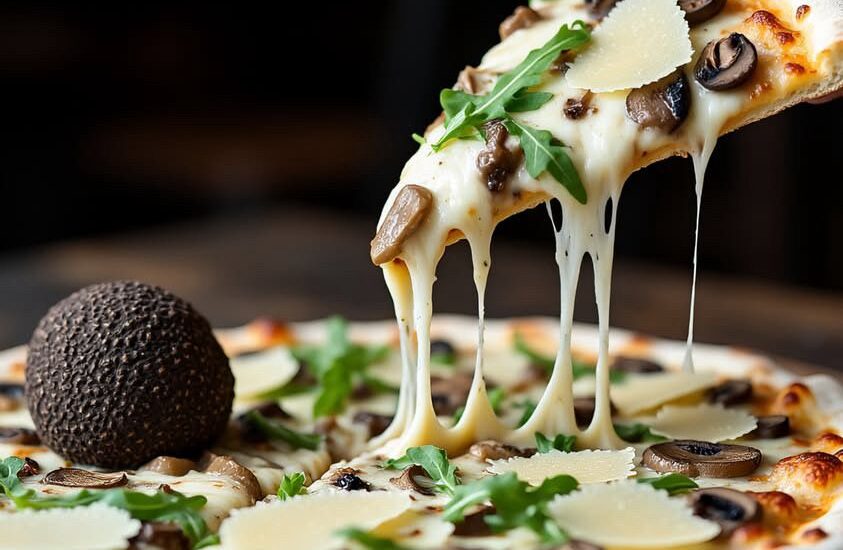
The most popular truffle oil pizza combinations tend to involve ingredients that can stand up to its earthy intensity. Mushroom pizza is the obvious pairing; something like a roasted cremini and fontina pizza finished with white truffle oil is genuinely hard to improve upon. But I have also seen truffle oil do remarkable things on a simple margherita, where its earthiness plays against the bright acidity of San Marzano tomatoes and the freshness of basil in a way that feels surprisingly balanced. Even a basic cheese pizza gets a serious gourmet upgrade when truffle oil enters the picture.
At Pizzapedia, we think a lot about what separates a good pizza from a genuinely memorable one. Truffle oil occupies an interesting space in that conversation because it is both accessible and transformative. You can find a decent bottle at most grocery stores for under fifteen dollars, which means you do not have to be eating at a high-end restaurant to experience what truffle oil brings to a pizza. That accessibility is part of what makes it such an exciting ingredient for home pizza makers. You do not need a wood-fired oven or professional-grade dough to produce something that tastes genuinely luxurious.
That said, restraint is the whole game with truffle oil. A little goes a long way. The first time I used it at home, I applied it the way I would drizzle olive oil generously and without much thought. The result was overpowering, almost medicinal, and it buried every other flavor on the pizza under a wall of earthiness. Half a teaspoon across an entire twelve-inch pie is usually more than enough. The goal is to add a finishing note, not to conduct the entire flavor orchestra yourself.
If you are building a truffle oil pizza from scratch, the combination of ingredients matters more than you might expect. Thin, crispy crust tends to work better than thick or chewy dough because it does not compete with the oil’s intensity for your attention. Creamy cheeses like goat cheese, burrata, or taleggio create a richer base that truffle oil can sink into beautifully. Arugula, thinly sliced prosciutto, and a shower of shaved Parmesan are classic finishing companions. The whole thing comes together in a way that feels effortlessly elegant, which, when you think about it, is exactly what the best pizza always does.
Truffle oil has earned its place in the serious pizza kitchen, not as a gimmick or a status symbol, but as a genuinely useful tool for adding depth and complexity to a dish that already has a lot going for it. Whether you are experimenting at home or rethinking your approach to gourmet pizza toppings, it is worth keeping a small bottle in your pantry. Use it carefully, use it after the oven, and let it do what it does best, which is make everything around it taste a little more extraordinary.
Reference
Besson, I., Bermúdez-Aguirre, D., & Vega-Castro, O. (2022). Truffle aroma: A review of volatile compounds and their biosynthesis. Food Chemistry, 386, 132–144. https://doi.org/10.1016/j.foodchem.2022.132144
Ercoli, S., Schillaci, G., Vita, F., & Pacioni, G. (2015). Influence of host plant and soil characteristics on the chemical and sensorial profiles of Tuber melanosporum truffles. Food Chemistry, 188, 242–248. https://doi.org/10.1016/j.foodchem.2015.04.065
Talou, T., Gaset, A., Delmas, M., Kulifaj, M., & Montant, C. (1990). Dimethyl sulphide: The secret for black truffle hunting by animals? *Mycological Research, 94(2), 277–278. https://doi.org/10.1016/S0953-7562(09)80625-5