
 Posted by
 Scattered or orderly pepperoni placement? I tested both on homemade pizza and share what changes in crispiness, grease, and slice fairness. Find your style. I used to think pepperoni placement was the least interesting question in the whole pizza universe. Then I spent one Friday night making six pizzas for a group of friends, and I watched an actual argument break out over whether the slices looked “right.” One friend wanted every pepperoni circle lined up like little soldiers. Another insisted that tossing them on randomly was the only honest way to build a pie. I stood there with flour on my forearm, holding a bag of sliced pepperoni, realizing I had no real opinion. That changed fast.
So let me walk you through what I have figured out since then, because the scattered versus orderly debate turns out to matter more than you would think.
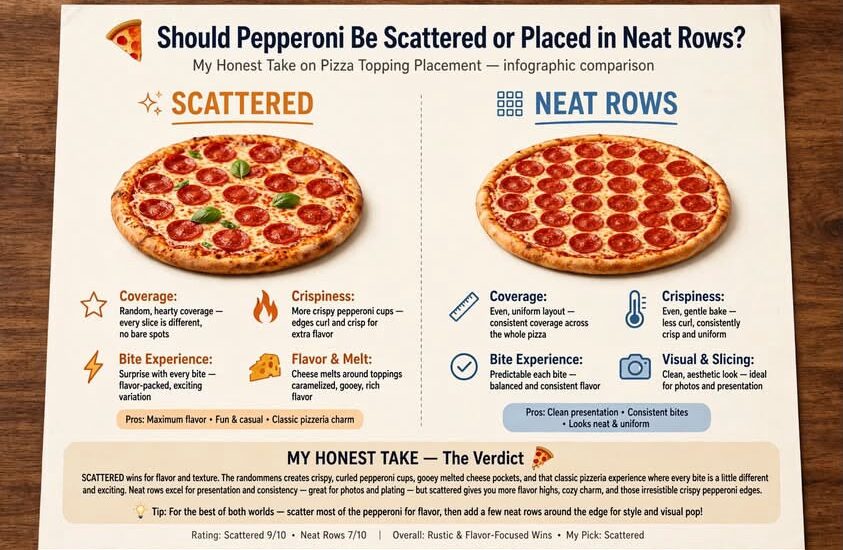
Start with the orderly approach, since that is where most pizzerias land. When you arrange pepperoni in concentric rings or a tidy grid, every slice of pizza gets a predictable amount of topping. Cut an eight-slice pie and each wedge holds roughly the same number of pepperoni circles, maybe two or three. There is something deeply satisfying about that fairness. Nobody gets stuck with the bare, sad slice while their cousin walks off with a pepperoni jackpot. I have seen grown adults count the circles on their slice, and I will admit I have done it too.
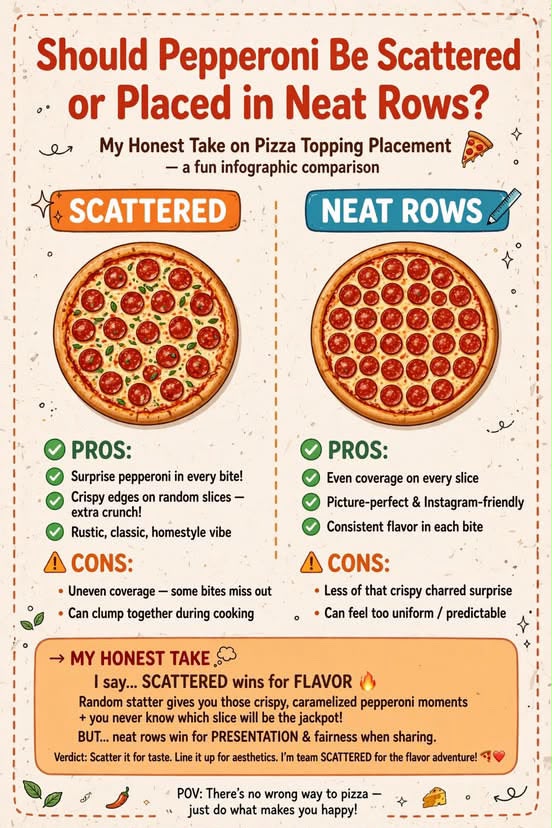
Orderly placement also makes life easier if you are cooking at any kind of volume. When I worked a short stint helping at a friend’s pop-up pizza stand, we used a simple rule: one ring around the outer edge, one ring inside that, and a single pepperoni dropped in the center. It took maybe fifteen seconds per pizza, and the results were consistent. Consistency is not glamorous, but it keeps customers coming back. If you are trying to bake the same pepperoni pizza at home every weekend and get the same result, a pattern is your friend.
Now, the scattered camp. I get the appeal, honestly. A random spread feels rustic and generous, like someone made your pizza with their hands rather than a template. And there is a practical side too. Pepperoni releases grease as it cooks, and when the slices overlap or cluster a little, they curl and cup, holding tiny pools of spicy orange oil. Those crispy, charred edges people rave about, the ones often called cupping pepperoni? They tend to happen more when the slices are given a bit of chaos to work with. A neat single layer can cook flat and a little dull by comparison.
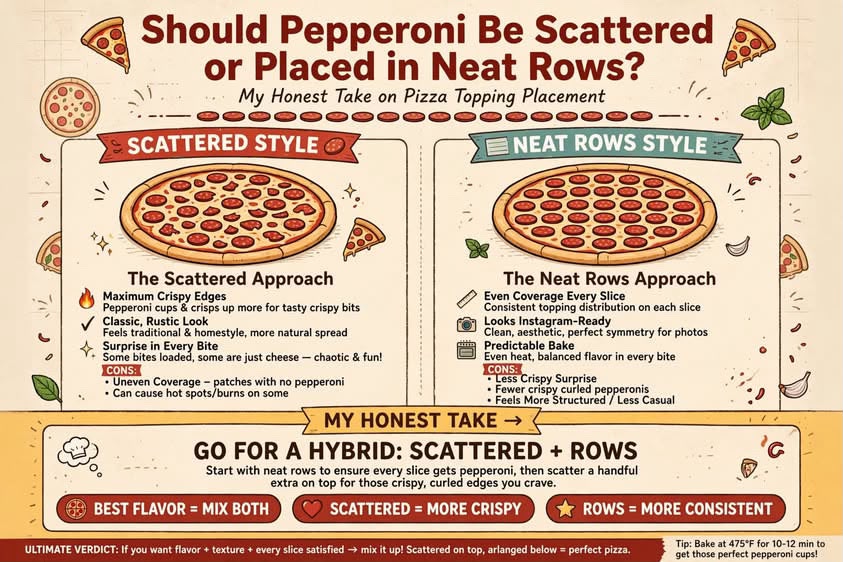
I learned this the hard way one evening when I decided to be fancy. I laid out a perfect spiral of pepperoni on a homemade dough, stood back like an artist admiring a canvas, and slid it into a very hot oven. Twelve minutes later, the pizza looked beautiful and tasted fine, but it was missing that crunchy, blistered edge I love. The next night I threw the slices on more casually, let a few overlap, and pulled out a pie that made me weirdly happy. Same dough, same sauce, same cheese. Different pepperoni placement, noticeably different bite.
Does that mean scattered wins? Not so fast. The trouble with a loose spread is that cheese and sauce need room to breathe. Pile too many pepperoni slices in one spot and you end up with a greasy puddle in the middle, a soggy section that never quite firms up. I have made that mistake more than once, usually when I am distracted or hungry, which is to say most of the time. Uneven coverage can also leave one slice loaded and another practically naked, which brings back the fairness problem from earlier.
Here is where I have landed, for what it is worth. For a classic pepperoni pizza I am serving to people I care about, I go with a loosely organized pattern. I place the slices in a rough ring pattern but do not fuss over perfect spacing, and I let a couple overlap on purpose. It is a compromise, sure, but it gives me even distribution without sacrificing those crispy, curled edges. If I am making a thin crust pizza, I lean a little more orderly, since a thin base cannot handle heavy pockets of grease. On a thick, pan-style pie, I go looser and let the pepperoni do its thing.
Another small trick worth mentioning: the type of pepperoni matters just as much as where you put it. Natural casing pepperoni, the kind that cups and chars beautifully, behaves very differently from the flat, uniform slices you find in a standard grocery pack. If you are chasing that crisp, curled texture, placement and pepperoni choice work as a team. I did not appreciate this until I ran a side-by-side test in my own kitchen, and the difference was hard to ignore.
So which side are you on? Honestly, I think the best pepperoni pizza placement depends on your crust, your oven, and how much you enjoy a little kitchen chaos. Try both, take notes, and let your own taste buds settle the argument. Just do not be surprised if your friends start counting circles.
Reference
Smith, J. L. (n.d.). Sausage drying: Factors affecting the percent yield of pepperoni. ResearchGate. https://www.researchgate.net/publication/230355966_Sausage_drying_Factors_affecting_the_percent_yield_of_pepperoni
Faith, N. G., et al. (1997). Viability of Escherichia coli O157:H7 in pepperoni during the manufacture of sticks and the subsequent storage of slices under various conditions. International Journal of Food Microbiology, 37, 47–54. U.S. Department of Agriculture, Food Safety and Inspection Service. https://www.fsis.usda.gov/sites/default/files/media_file/2021-09/Faith-1997.pdf
Pork Information Gateway. (2015). Dry and semi-dry fermented and direct acidified sausage validation. U.S. Department of Agriculture, Agricultural Marketing Service; Iowa State University. https://porkgateway.org/resource/dry-and-semi-dry-fermented-and-direct-acidified-sausage-validation/