 Posted by
 I never thought a pizza could be political. It was just dinner. A cheap, satisfying meal shared with friends. Then I stumbled across a photograph from 1992 that made me rethink everything. There was Bill Clinton, standing in a pizza kitchen, grinning, holding up a slice. The caption mentioned something about a campaign stop and the politics of the working class. That single image sent me down a rabbit hole. I learned that pizza has been used as a political symbol for decades, and its meaning has shifted with the cultural tides.
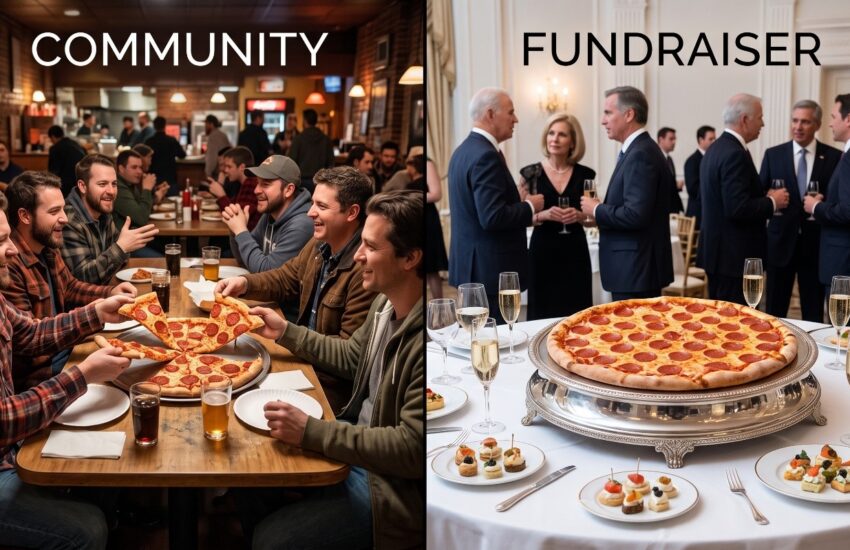
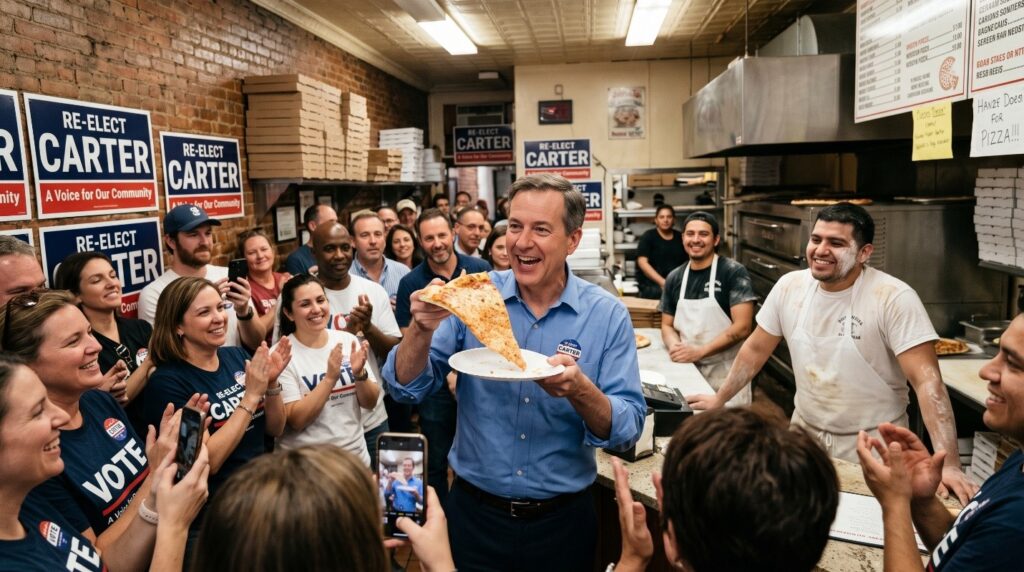
Pizza became a political prop because it is a food of the people. It is not elitist. It is not fancy. It is accessible, affordable, and universally loved. When a politician wants to signal that they are down to earth, that they understand ordinary Americans, they eat pizza. They visit local pizzerias. They pose with slices. They talk about growing up in neighborhoods where pizza was a Friday night ritual. It is a form of culinary populism.
The 1992 presidential election was a turning point. Bill Clinton was running against George H.W. Bush, a man who seemed out of touch with everyday Americans. Clinton, by contrast, was young, charismatic, and hungry for connection. He famously stopped at a McDonald’s and a pizzeria during his campaign. He did not just eat the food. He engaged with the people. He listened. He laughed. He made voters feel seen. The pizza was not the point. The pizza was the backdrop for a larger message. Clinton was the candidate who understood you.
But pizza as a political symbol goes deeper than campaign photo ops. It has been used to signal ethnicity, class, and regional identity. In the 1950s and 1960s, pizza was still considered an ethnic food, associated with Italian immigrants. When John F. Kennedy ate pizza in public, it was a signal that he was comfortable with immigrant communities. When politicians visit Black-owned pizza shops, they are signaling solidarity with Black entrepreneurship. When they eat at local pizzerias instead of chain restaurants, they are signaling support for small business.
Pizza has also been a battleground in the culture wars. In 2017, a pizzeria in Indiana refused to cater a same-sex wedding, sparking a national debate about religious freedom and discrimination. The pizzeria became a symbol, first for conservative Christians who saw it as a defense of their values, then for a liberal backlash that painted it as bigoted. The pizza was just pizza. The meaning attached to it was enormous.
More recently, pizza has been used to mock political opponents. When Donald Trump served fast food at a White House event for the Clemson football team, critics called it classless. When politicians are photographed cutting pizza with a fork and knife, they are mocked as out of touch. The way you eat pizza has become a litmus test for authenticity. Fold it, and you are a man of the people. Fork it, and you are a snob.
I find this fascinating because it reveals something true about American politics. We do not just debate policies. We debate symbols. We debate who belongs, who understands, and who is truly one of us. Pizza is a convenient prop because it is so universally liked. But it is also a canvas onto which we project our anxieties about class, race, and belonging.
What does pizza mean in politics? It means whatever we want it to mean. It means working-class solidarity. It means ethnic pride. It means small business support. It means religious freedom. It means culinary authenticity. It means everything and nothing. That is the power of a symbol. It is empty until we fill it with meaning. And we fill it constantly.
I still eat pizza without thinking about any of this. But sometimes, when I see a politician holding a slice, I pause. I look at the image. I ask what message is being sent. And I remember that even the simplest things can become political in the right hands.
References
World Press Photo. (1993). *Bill and Hillary Clinton relax after a late-night pizza party* [Photograph]. [https://www.worldpressphoto.org/collection/photo-contest/1993/p-f-bentley/3](https://www.worldpressphoto.org/collection/photo-contest/1993/p-f-bentley/3)
Smithsonian Magazine. (2016). *The history of the town hall debate*. [https://www.smithsonianmag.com/history/history-town-hall-debate-180960705/](https://www.smithsonianmag.com/history/history-town-hall-debate-180960705/)
EBSCO Research Starters. (2022). *1992 elections in the United States*. [https://www.ebsco.com/research-starters/history/1992-elections-united-states/](https://www.ebsco.com/research-starters/history/1992-elections-united-states/)
Pizzapedia. (2025). *How pizza became a powerful political symbol in American campaigns*. [https://pizzapedia.org/how-pizza-became-a-powerful-political-symbol-in-american-campaigns/](https://pizzapedia.org/how-pizza-became-a-powerful-political-symbol-in-american-campaigns/)