
 Posted by
 Explore the history of pizza advertising, from 1903 newspaper ads to modern TV commercials, and see how pizza marketing shaped American pizza culture. Last month I was digging through a box of old restaurant flyers at a flea market, and one faded coupon for a corner pizzeria stopped me in my tracks. Who wrote that cheerful little line about hot, fresh pies? And, maybe more importantly, how did we travel from a scrap of paper like that to the glossy, cheese-pull commercials that make me hungry late at night? That question is exactly why I love the history of pizza advertising, and it is a story we keep coming back to here at Pizzapedia.
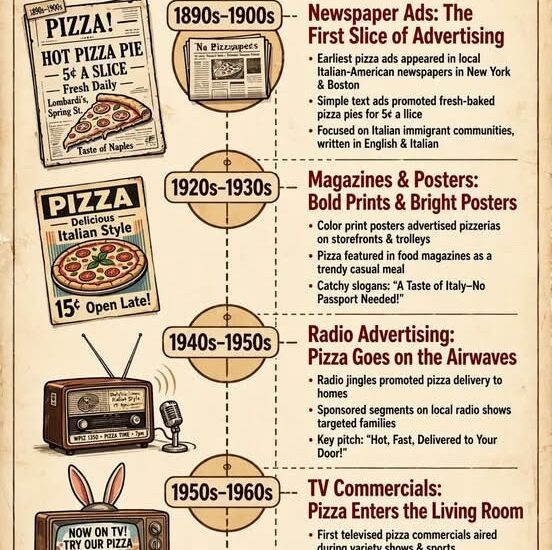
Let me start with a twist. For years, the popular story said that pizza in America began with Lombardi’s in 1905. Researchers have since turned up an ad from 1903 in an Italian-language New York newspaper, which means pizza was already being promoted to hungry immigrants before the famous license was ever issued. I find that wonderful, because it tells me advertising and pizza grew up together almost from the first day.
These early newspaper ads were not fancy. They were small, direct, and aimed at a very specific crowd, namely Italian immigrants who missed the food of home. Scholars who study food ads from that era note that sellers leaned hard on national pride and the comfort of familiar flavors. Honestly, I have always thought that was clever marketing, long before anyone called it a strategy. I did not expect a tiny newspaper notice to carry so much history, yet there it sits, quietly proving that pizza was a business as much as a meal.
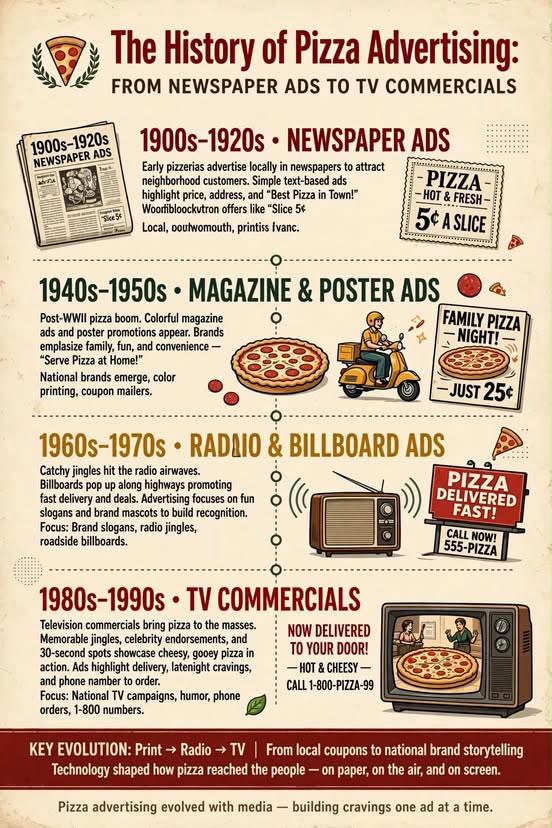
For decades pizza stayed mostly inside Italian neighborhoods. It started reaching other Americans in the 1930s and 1940s, and then the post-war boom really lit the oven. Returning soldiers who had tasted pizza overseas wanted more of it, or so the story goes, and new pizzerias popped up in places where Italian families were rare.
Here is the part that surprised me. To win over the rest of the country, pizza makers actually dialed down the Italian imagery. Early franchises, Pizza Hut among them, gradually dropped the old-country look from their advertising so that pizza felt like an everyday American treat rather than an exotic dish. Think about that for a second. A food sold itself by becoming less foreign, and it worked beautifully.
My own grandmother, who never trusted a restaurant she could not smell from the sidewalk, used to say the best advertisement was the aroma drifting out of a pizzeria door. She was not entirely wrong, but print ads, radio spots, and local coupons did the heavy lifting once pizza chains began to multiply.
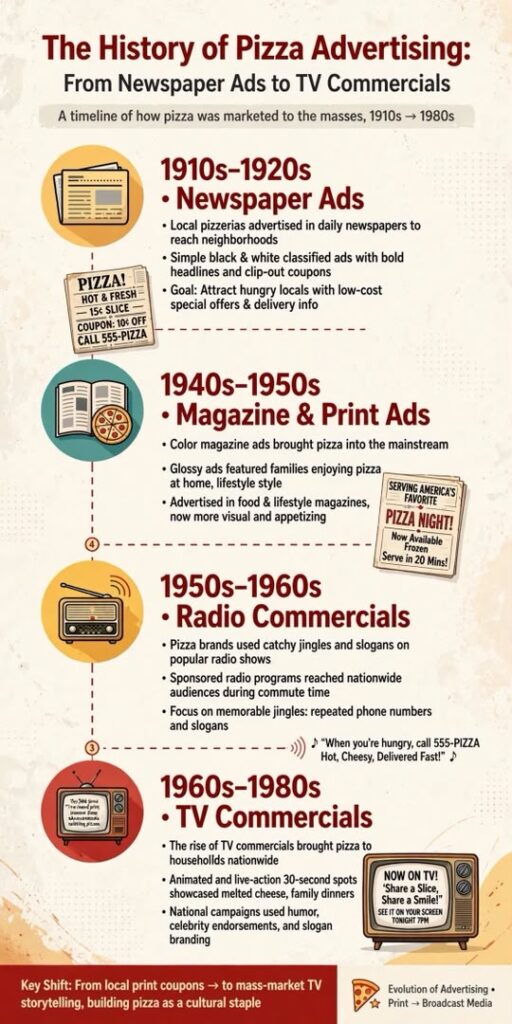
Then television arrived in nearly every living room, and pizza advertising changed again. A commercial could show steam, stretching cheese, and a family laughing around a table, all in about thirty seconds. I still remember a jingle from my childhood that I could not shake for days, no matter how hard I tried.
Delivery became the next big selling point. Domino’s built its reputation on a promise of fast delivery, and that promise made speed itself the product. Meanwhile, reading programs and kids’ promotions, like the Book It program from Pizza Hut, quietly tied pizza to happy childhood memories. Was that just a smart business move? Probably. Did it work on me? Absolutely, since I still associate a personal pan pizza with a gold star on a classroom chart.
Over time the commercials grew louder, funnier, and more competitive. Chains argued about crust, toppings, price, and speed, and viewers picked favorites almost like sports fans. I have friends who will defend their chosen brand with more passion than they bring to politics, which makes me smile every single time. It tells me those thirty-second stories really do land.
These days the story has moved to our phones. Short videos, app deals, and online ordering have replaced a lot of the old newspaper coupons, though I suspect the basic idea has not changed much since 1903. Somebody wants to tell a hungry person where to find a good pie, and they want to say it in a way that sticks.
Looking back, I notice a pattern. Each new medium, whether newspaper, radio, television, or the smartphone, gave pizza a fresh way to reach people, and pizza makers were quick to jump on it. Maybe that is why pizza feels so woven into everyday life.
At Pizzapedia we spend a lot of time on pizza varieties, cheeses, herbs, and pizza culture, but ads belong in that conversation too. They show us what people wanted, what they feared, and what they were willing to pay for on a Friday night. So the next time a pizza commercial catches your eye, pause for a moment and ask yourself what it is really selling. I bet the answer is more interesting than the cheese.
References
Chiaricati, F. (2022). Sons of our race! Buy Italian! Italian propaganda through food ads among Italian American ethnic communities at the turn of the century. History of Retailing and Consumption, 8(1), 49–68. https://doi.org/10.1080/2373518X.2023.2169298
Library of Congress. (n.d.). Chronicling America: Historic American newspapers. https://www.loc.gov/chroniclingamerica/