
 Posted by
 Explore the surprising history of pizza and food innovation, from the patented pizza cone to automated pizza vending machines, changing how the world eats. I grew up thinking pizza was simply something you ordered on a Friday night, a flat circle of dough and cheese that showed up in a cardboard box. It took me years of researching food history for Pizzapedia to realize that pizza is actually one of the most quietly revolutionary foods in modern history. Why does a dish that started as peasant food in Naples keep finding its way into vending machines, ice cream-style cones, and even space station menus? I think the answer says something about how humans treat food as a canvas for invention, not just sustenance.
Let me back up for a second. Pizza did not always look like the version most of us know today. Early Neapolitan pizza was simple, almost humble, built from whatever ingredients were affordable to working-class families. Tomatoes, a bit of cheese, some herbs, and bread dough that had been around in various forms for centuries. Nobody in nineteenth century Naples was imagining that this dish would someday be sold from a coin-operated machine on a street corner outside of Italy. Yet here we are.
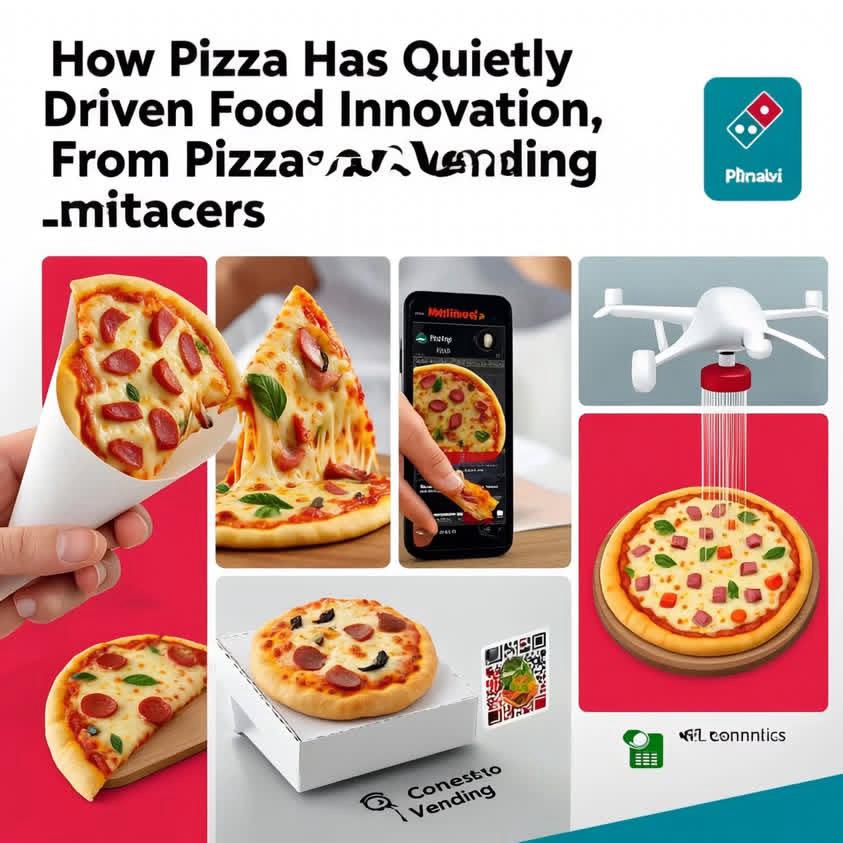
The pizza cone is one of my favorite examples of food innovation, taking something familiar and twisting it into something new. Instead of a flat pie, picture a cone-shaped crust, pizza dough wrapped around itself, filled with sauce, cheese, and toppings, then baked so it holds its shape like an edible cup. You eat it standing up, walking down a street, without a fork or a plate weighing you down. I tried one years ago at a food festival, and I remember feeling almost confused, in a good way, because my brain kept expecting a flat slice and instead I was holding something closer to an ice cream cone. That kind of reinvention is what keeps a centuries-old dish relevant to a generation that wants food fast, portable, and a little bit photogenic for social media.
Then there is the pizza vending machine, which honestly sounds like something out of a science fiction movie until you actually encounter one. These machines mix dough, add sauce and toppings, and bake a fresh pizza inside the unit itself, all within a few minutes, with no human hands required after you press the button. Is that strange? Maybe a little. But is it also kind of brilliant? I think so. It solves a real problem, getting hot, fresh food to people in places where a full restaurant kitchen does not make sense, like a college campus at two in the morning or a transit station where nobody wants to wait twenty minutes for a table.

What strikes me most about these food innovations is that they did not happen because pizza needed to be fixed. Pizza already worked. People already loved it. Food innovation in the pizza world has mostly been about access and convenience, not about improving flavor for its own sake. The vending machine and the cone both ask the same underlying question: how do we get this dish into more hands, more quickly, in more places? That is a very different motivation than, say, inventing a new flavor combination just to be clever.
I think about my own kitchen experiments sometimes, the nights I tried folding pizza into something portable for a road trip, failing more than once before getting something that held together without falling apart in the car. It gave me a small taste of what food innovators must feel, that mix of frustration and stubborn curiosity that pushes you to keep adjusting a recipe until it finally works the way you pictured it in your head.
Pizza has also found its way into more unexpected corners of food innovation, such as breakfast pizzas, dessert pizzas, and even astronaut-friendly versions designed for zero gravity. Each version asks the same question in a new context. How far can this dish stretch before it stops being pizza at all? I am not sure anyone has found the edge yet, and honestly, I hope nobody ever does.
What I find genuinely compelling about pizza history is that it mirrors a larger story about how comfort food evolves alongside technology and lifestyle. As life gets faster, food finds ways to keep pace, whether that means a cone you eat on the move or a machine that bakes your dinner while you stand there scrolling your phone. Pizza did not just survive these changes; it became a sort of testing ground for them.
So the next time you grab a slice, or maybe a cone, or even punch a code into a pizza vending machine, take a second to think about how strange and wonderful it is that this simple combination of bread, sauce, and cheese has managed to stay at the center of food innovation for well over a century. I doubt the dish is finished evolving, and frankly, I cannot wait to see what shape it takes next.
References
Rhodes, D. G., Adler, M. E., Clemens, J. C., LaComb, R. P., & Moshfegh, A. J. (2014). Consumption of pizza: What we eat in America, NHANES 2007–2010 (Food Surveys Research Group Dietary Data Brief No. 11). U.S. Department of Agriculture, Agricultural Research Service.
Nowak, Z. (2015). Interview with Antonio Mattozzi, author of Inventing the Pizzeria: A History of Pizza Making in Naples. Gastronomica: The Journal of Critical Food Studies, 15(4), 1–5. https://doi.org/10.1525/gfc.2015.15.4.1
Gubbini, A., & Demaggio, G. (2003). Vending apparatus for dispensing hot pizzas (U.S. Patent No. 6,550,632). United States Patent and Trademark Office.