
 Posted by
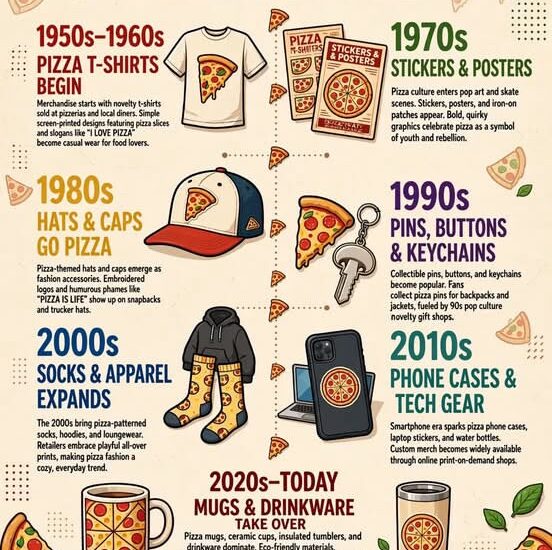
 Explore the history of pizza merchandise, from promo pizza t-shirts to quirky pizza mugs, and see how pizza culture turned loyal fans into walking billboards. I own a faded pizza t-shirt that I bought at a county fair when I was about twelve, and I wore it until the collar finally gave up. I have thought about that shirt more often than I would like to admit. Why did I love it so much? A cartoon slice wearing sunglasses on a cotton tee should not mean anything, yet it did. That little question sent me down the rabbit hole of pizza merchandise history, and honestly, I have not climbed out since. On Pizzapedia I spend most of my time with cheeses, herbs and regional pies, but the things people wear and sip from tell their own story about pizza culture.
To understand pizza themed merchandise, I first had to accept that pizza was not always cool. In the United States it lived mostly inside Italian immigrant neighborhoods for decades. According to Smithsonian Magazine, few people in the mainstream knew or cared what pizza was until after World War II, when service members who had been stationed in Italy came home with a craving for it (Daley, 2019). That craving fed the first big pizza boom and the early pizza chains of the 1950s. Here is the part I find fun: nobody prints a t-shirt for a food nobody loves. Merchandise only shows up once a food becomes part of everyday life.
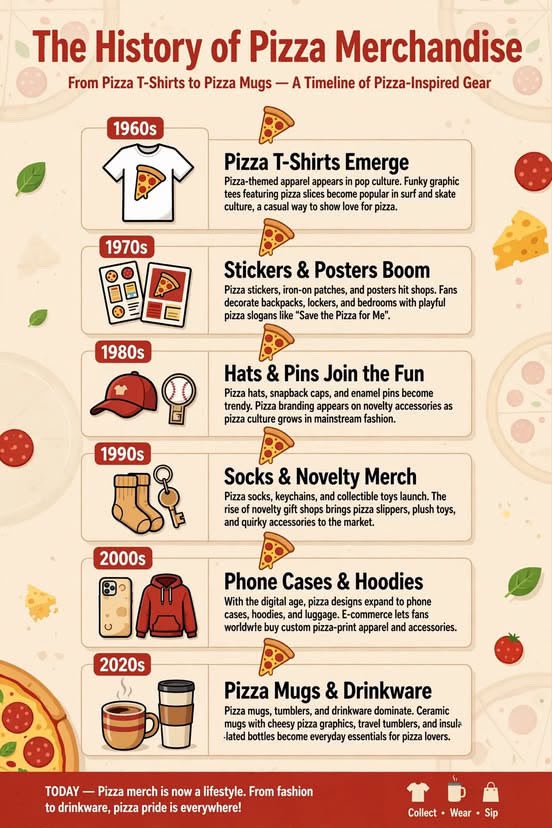
The t-shirt itself had to grow up too. It started out as underwear, drifted into workwear, and only later became a canvas for words and pictures. By the 1970s and 1980s, printed tees were a normal way to announce who you were and what you believed. The Smithsonian’s National Museum of American History holds examples such as a “Feminist and Proud” shirt from a 1977 convention and a “Justice for Janitors” shirt from 1988 (National Museum of American History, n.d.-a, n.d.-b). Those shirts are about politics, not pizza, but they matter here. They prove that a plain shirt could carry a loud message, and sooner or later pizza brands and pizza fans noticed.
My best guess, and I admit it is only a guess, is that the earliest pizza t-shirts were simple promotional items. A local pizzeria would hand one to the delivery crew or to the softball team it sponsored, and the logo on the chest worked as a walking advertisement. As pizza chains multiplied, those logos got bigger and bolder. Then something shifted. People started wearing the shirts because they loved the pizza, not because anyone handed them one. Is that not a funny little reversal? The customer became the billboard, and a very happy one at that.
Pizza mugs came along on a slightly different road. A mug is a quieter object. It sits on a desk, on a kitchen shelf, in a break room, and it gets used every single day. I remember my uncle keeping a chipped mug from his favorite neighborhood pizzeria, stuffed with pens, long after the restaurant closed. It was not valuable, but he would not part with it. Mugs, I think, turned pizza from an occasional dinner into a daily companion. Even a plain morning coffee could carry a little pepperoni pride.
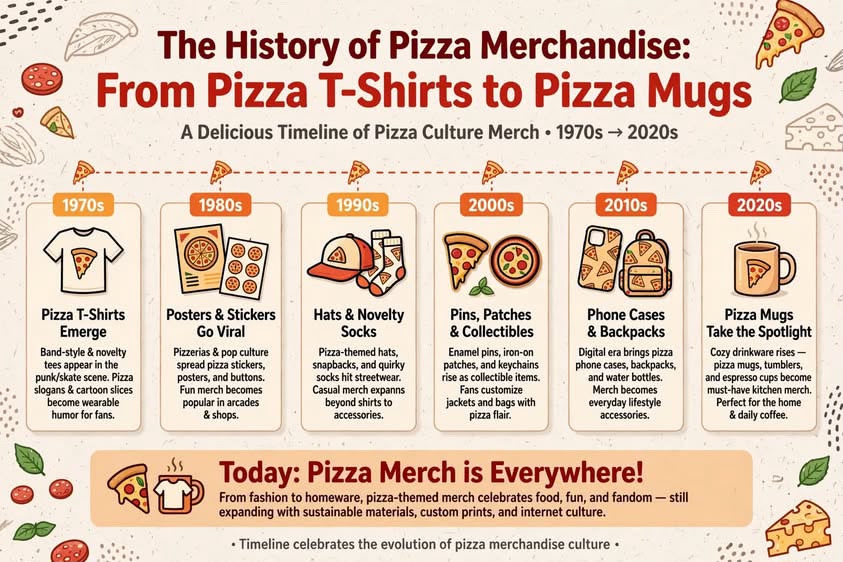
Somewhere along the way the humor arrived. Puns, cartoon slices and slogans about loving pizza more than people filled the shelves. Collectors began hunting for vintage pizza chain shirts and old promotional mugs, and online marketplaces gave them a place to trade. Today pizza apparel and pizza gifts make up a whole category, from enamel pins to socks covered in melted cheese. Print on demand technology means one person with a funny idea can launch pizza themed merchandise without owning a warehouse. I find that wonderful, even if my closet is now overflowing.
So what does all of this say about pizza culture? I think it says that we do not just eat pizza, we belong to it. Wearing a pizza t-shirt is like joining a very large, very friendly club with no membership fee, and sipping from a pizza mug is a small private nod to the same club. The story of pizza merchandise is really the story of pizza moving out of immigrant kitchens and into the center of everyday life, one logo at a time.
Next time you spot a pizza t-shirt at a flea market or a battered pizza mug in a thrift store, pick it up and turn it over. Ask where it came from. I will keep digging into stories like these on Pizzapedia, because a good slice deserves a good story, and sometimes that story is printed right across the front of a shirt. Where does your favorite pizza souvenir come from? I would love to hear about it.
References
National Museum of American History. (n.d.-b). T-shirt, “Justice for Janitors” (Accession No. 1988.0520.005) [Museum object record]. Smithsonian Institution. https://si.edu/object/t-shirt-justice-janitors:nmah_1051345
National Museum of American History. (n.d.-a). T-shirt, “Feminist and proud” (Accession No. 1977.0661.01) [Museum object record]. Smithsonian Institution. https://si.edu/object/t-shirt-feminist-and-proud%3Anmah_496790
Daley, J. (2019, February 8). The father of American pizza is not who we thought he was. Smithsonian Magazine. https://www.smithsonianmag.com/smart-news/father-american-pizza-not-who-we-thought-it-was-180971454/