

 Posted by
 Explore how pizza toppings evolved from ancient flatbreads to modern gourmet creations and discover the fascinating history behind every delicious slice. I remember the first time I truly stopped to think about what was sitting on top of my pizza. It was a simple margherita, nothing fancy, but something about the way the basil wilted into the tomato sauce made me wonder how all of this ended up here, on a round piece of dough, inside a cardboard box, in my living room. Pizza toppings carry a history that most people never think about. They just order, they eat, they move on. But the story behind what we pile onto our pizza dough is genuinely fascinating, and honestly, I think it deserves a lot more attention than it gets.
The earliest forms of pizza toppings were not anything like what we recognize today. Ancient flatbreads, eaten across the Mediterranean long before Naples ever existed, were often dressed with olive oil, salt, and whatever herbs grew nearby. The Romans had a version called placenta, which was layered with cheese and honey. The Greeks loaded their flatbreads with onions, garlic, and local legumes. None of this resembled modern pizza exactly, but the fundamental idea, using bread as a base for other flavors, was already deeply embedded in the culture of the region. The evolution of pizza toppings really starts there, in those humble kitchens of the ancient world, long before anyone was calling it pizza.
The tomato changed everything. When tomatoes arrived in Europe from the Americas in the sixteenth century, the initial reaction across much of the continent was suspicion. People thought they were poisonous, or at best, decorative. But in Naples, among the poorer communities, tomatoes were embraced quickly. They were cheap, they were abundant, and they tasted good on flatbread. By the eighteenth century, Neapolitan street vendors were already selling something recognizable as pizza, topped with tomato, and sometimes a little lard or cheese. This was the moment the modern pizza topping history really began to take shape, even if the options were still limited by necessity rather than preference.
Mozzarella entered the story gradually. The famous legend of the Margherita pizza, supposedly created in 1889 for Queen Margherita of Savoy with tomato, mozzarella, and basil representing the colors of the Italian flag, is probably more romantic than strictly accurate. But the story stuck, and it helped establish a particular idea of what a pizza topping combination could look like. Whether the legend is true or embellished, it marks a cultural moment. It is the point where pizza toppings began to be discussed in terms of identity and meaning, not just sustenance.
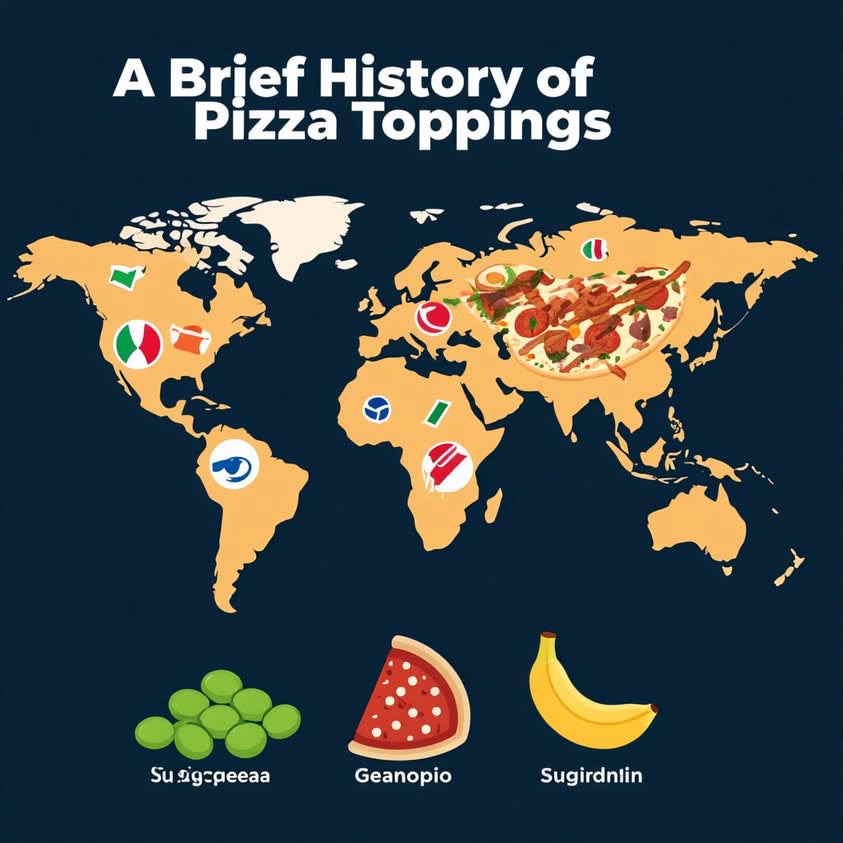
The twentieth century is where things get genuinely wild in terms of pizza topping evolution. When Italian immigrants brought pizza to the United States, the toppings started to shift in ways that would have baffled anyone from Naples. Pepperoni, which has essentially no equivalent in traditional Italian cuisine, became the most popular pizza topping in America. The combination of cured meats, cheeses, and vegetables that Americans began piling onto their pizzas reflected local tastes, ingredient availability, and an appetite for something more indulgent than the restrained Neapolitan original. This was not corruption of a tradition. It was adaptation, and it is part of why pizza became one of the most consumed foods on the planet.
What strikes me most about the history of pizza toppings is how much regional culture shapes them. In Japan, corn and mayonnaise are common. In Brazil, green peas appear regularly. In India, paneer and spiced vegetables show up on menus as naturally as pepperoni does in Chicago. Each of these variations is a direct reflection of what that culture values in food, what is locally available, and how the idea of pizza gets filtered through a different culinary imagination. The pizza topping, in a sense, becomes a mirror. It tells you something about where you are and who is eating.
Even within Italy, the regional variation in pizza toppings is significant and often underappreciated. Roman pizza is different from Neapolitan. Sicilian pizza has its own entirely distinct character. Toppings like anchovies, capers, and strong local cheeses appear in ways that feel completely natural in one region and almost alien in another. This internal variation within the country that supposedly invented pizza is a reminder that the history of pizza toppings was never a straight line. It was always a branching, messy, delicious argument between different communities about what belonged on the dough.
The modern era has brought something interesting to the conversation. Gourmet pizza has pushed topping choices into territory that would have seemed absurd even thirty years ago. Truffle oil, burrata, prosciutto di Parma, fig and arugula, roasted beet with goat cheese, these are all toppings that have appeared on menus at serious restaurants, and they signal that pizza has fully crossed over from street food to something that chefs take seriously as a creative medium. At the same time, the classics have not gone anywhere. Pepperoni still dominates. Cheese and tomato still anchor the menu.
Reference
U.S. Department of Agriculture, Economic Research Service. (2022). Pizza: America’s favorite food. https://www.ers.usda.gov
Mintz, S. W., & Du Bois, C. M. (2002). The anthropology of food and eating. Annual Review of Anthropology, 31(1), 99–119. https://doi.org/10.1146/annurev.anthro.32.032702.131011
Counihan, C. M. (1999). The anthropology of food and body: Gender, meaning, and power. Routledge.