
 Posted by
 Crispy crust or chewy crust? Explore the dough science behind pizza crust texture, from gluten development to hydration, fermentation, and oven heat used. I have eaten a genuinely embarrassing amount of pizza while researching for Pizzapedia, and if there is one debate that gets readers fired up faster than pineapple on pizza, it is this one. Crispy crust or chewy crust. I used to think it was a silly question, honestly. Pizza is pizza, right? Then I spent a weekend making six different doughs in my kitchen, comparing crust texture side by side, and I realized how wrong I was. The crust is not just a vehicle for cheese and sauce, it is the entire architecture of the pizza, and the choice between crispy and chewy changes how a slice feels in your hand and tastes in your mouth.
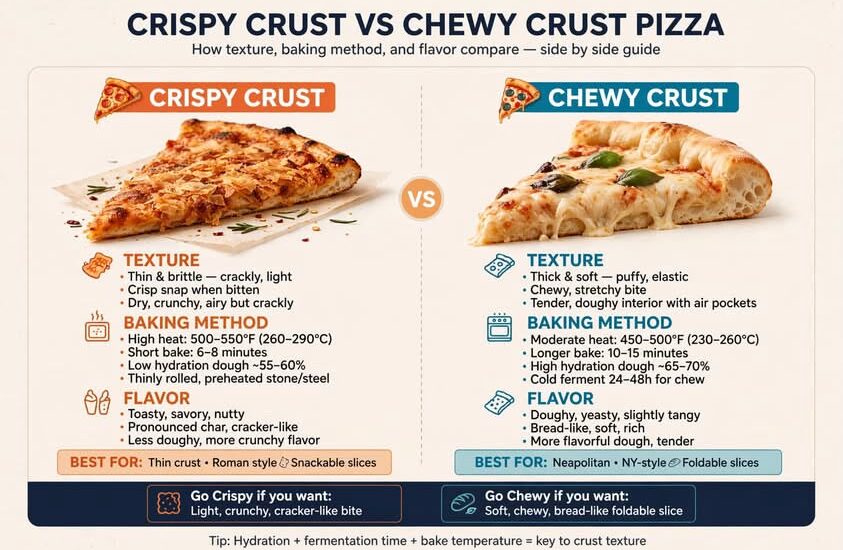
Let me start with crispy crust, because that is the one I grew up loving. My dad used to take me to a tiny place near our old apartment that baked thin-crust pizza in a blistering hot oven, and the crust would crackle audibly when you picked up a slice. That sound still gets me. Crispy pizza crust generally comes from lower hydration dough, meaning less water relative to flour, baked fast and hot so the surface dries out and browns before the inside gets a chance to steam. High oven temperatures drive a process called the Maillard reaction, which is the chemistry behind that deep golden color and toasty flavor on a well baked crust. Researchers who study bread and pizza crust formation have pointed out that as the crust loses moisture during baking, it can exceed the boiling point of water, which is exactly what drives that browning and flavor development (Purlis, 2010).
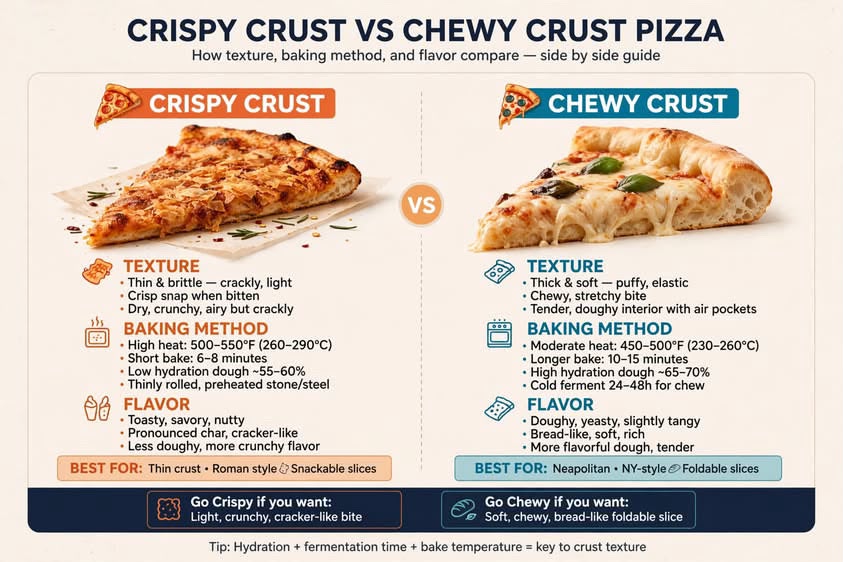
Chewy crust, on the other hand, asks something different of the dough. Do you ever notice how a chewy slice seems to fight back a little when you bite into it, in a good way? That resistance comes largely from gluten, the protein network formed when flour proteins interact with water and get worked through kneading. Higher protein flour, like bread flour, tends to build a stronger gluten structure, and that structure is largely responsible for the pleasant tug and stretch of a chewy New York style slice (Shewry, 1992). I remember trying to replicate a chewy Brooklyn style pie at home and completely underestimating how much kneading time mattered. My first attempt came out dense and tough in the wrong way, not chewy in the satisfying sense. There is a difference between a crust that chews well and a crust that resists you like a piece of rubber, and figuring out where that line sits took more failed dough balls than I care to admit.
Hydration plays its own strange role here, and it does not always behave the way people assume. You would think more water in the dough automatically means a softer, chewier bite, but that is not quite right. Higher hydration doughs tend to produce a more open, airier crumb structure with bigger bubbles, and this often leads to a crispier exterior rather than a chewier one, because that extra moisture escapes and browns the surface efficiently during baking. Meanwhile, dough that is under-hydrated or dense with flour can end up tough and chewy in a way nobody actually wants, since the gluten never fully develops the softness that comes with proper fermentation. So chewiness is not simply about water content, it is a tangled mix of gluten strength, hydration, fermentation time, and how flour proteins interact with all of that liquid (Zhan et al., 2019).
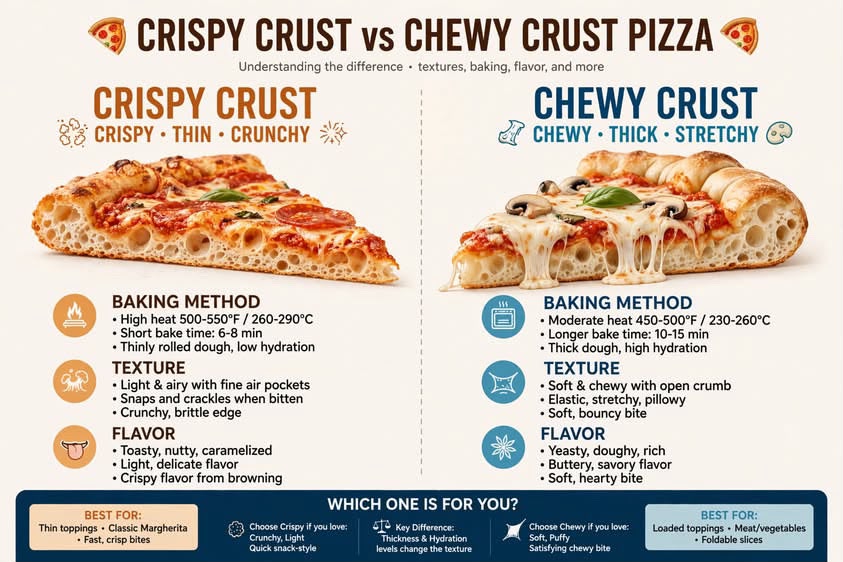
Fermentation might be the most underrated player in the crispy versus chewy conversation. A longer, slower rise gives yeast time to develop flavor and gives gluten time to relax, which changes how the finished crust behaves in the oven. I have noticed that dough I let sit in the fridge overnight, sometimes even two days, comes out with a noticeably different character than same day dough, more complex, a little tangier, and easier to shape without fighting me. Is that patience always worth it? Most days, yes. Some nights I just want pizza in ninety minutes and I accept a slightly less impressive crust as the tradeoff.
So which one wins, crispy or chewy? I genuinely do not think there is a correct answer, and anyone who tells you otherwise is probably selling something. Crispy crust brings a shattering bite and toasty depth that pairs beautifully with a thin layer of toppings, the kind of pizza you eat standing up because it barely needs a plate. Chewy crust brings substance, that satisfying pull of gluten, the kind of foundation that holds up under a heavier load of cheese and sauce without collapsing. My own preference shifts depending on my mood and which topping combination I am working with that day. A stressful afternoon calls for chewy comfort food energy. A lazy Sunday calls for something crisp and light.
Reference
Purlis, E. (2010). Browning development in bakery products – A review. Journal of Food Engineering, 99(3), 239–249. https://doi.org/10.1016/j.jfoodeng.2010.03.008
Shewry, P. R. (1992). Exploring the structure and functionality of wheat gluten proteins. Biotechnology & Biotechnological Equipment, 6(2), 19–24. https://doi.org/10.1080/13102818.1992.10818646
Zhan, J., Ma, S., Wang, X.-X., Li, L., & Zheng, X.-L. (2019). Effect of baked wheat germ on gluten protein network in steamed bread dough. International Journal of Food Science & Technology, 54(10), 2839–2846. https://doi.org/10.1111/ijfs.14200