
 Posted by
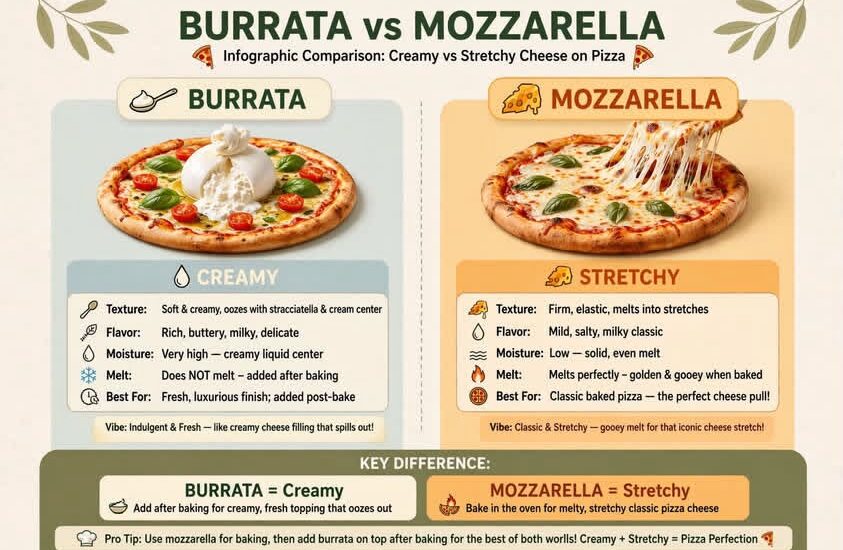
 Burrata versus mozzarella on pizza: which cheese really wins? Compare melt, texture, and flavor, plus the timing trick for a creamy homemade pizza topping.I have burned my tongue on more slices than I care to admit, all in the name of cheese research. That is not an exaggeration. Somewhere between my third and fourth pizza night trying to settle the burrata versus mozzarella debate, I realized this was not a question with one correct answer, but I still wanted to figure out which one deserved the crown on my own pie.
Let me start with mozzarella, because it is the cheese most of us grew up with. Low moisture, part skim, shredded straight from a bag or sliced fresh from a ball sitting in brine. It melts evenly, it stretches into that iconic cheese pull everyone films for social media, and it does not fight for attention with the sauce or the crust. Fresh mozzarella, the kind you find at an Italian deli or a farmers market stall, brings a milkier flavor and a softer bite, but even that version behaves itself once it hits a hot oven. Mozzarella is a team player. It melts, it browns a little at the edges if you are lucky, and it lets the rest of the pizza do the talking.
Burrata is a different animal entirely, and honestly, calling it a pizza cheese feels like a slight understatement. Burrata is the more dramatic cousin of mozzarella, a pouch of stretched curd filled with soft strands of cheese and cream, called stracciatella, that spills out the moment you cut into it. Have you ever sliced into a fresh burrata and watched that cream pool across the plate? It is almost theatrical. On pizza, though, burrata behaves very differently from mozzarella, and that difference is the whole reason this comparison matters. If you throw burrata onto a pizza and bake it like you would with mozzarella, you end up with a soupy, broken mess. The cream separates, the exterior toughens, and the interior goes runny in a way that is not pleasant.
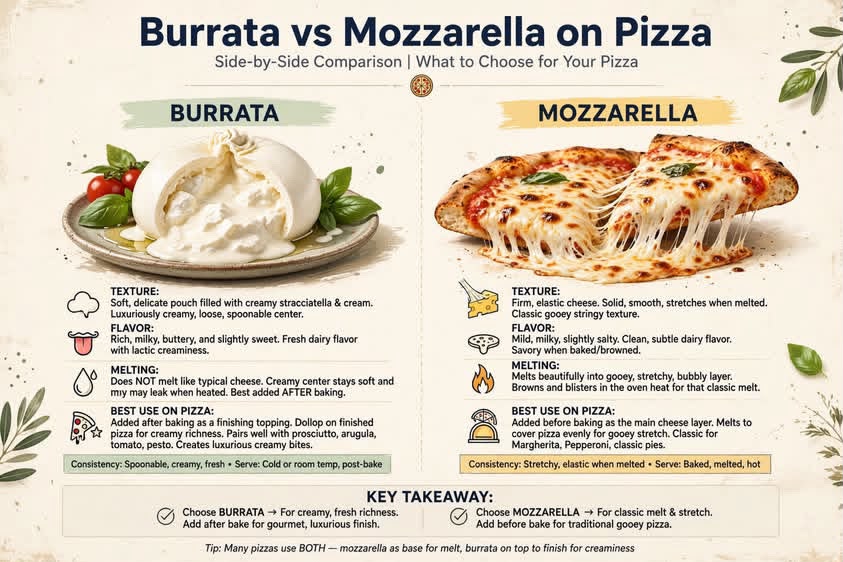
The trick with burrata pizza, and I learned this the hard way after ruining a perfectly good Margherita, is timing. Burrata does not belong in the oven. It belongs on top of the pizza after it comes out, torn apart with your hands or a spoon so the cream spreads naturally over the hot crust. The residual heat softens it just enough without breaking it down completely. That is the move. Bake your pizza with your sauce, your mozzarella or a light dusting of parmesan if you want more savory depth, pull it from the oven, then tear fresh burrata across the top. The contrast between the crisp crust, the warm sauce, and the cool, creamy burrata is honestly one of my favorite textures in food, pizza or otherwise.
So which cheese wins? I hate to dodge the question, but it really depends on what kind of pizza night you are having. If I am making a weeknight pizza for my family, something quick with pepperoni or mushrooms, mozzarella is doing exactly what it needs to do. It is reliable, it is affordable, and it does not require any special handling. Burrata, on the other hand, feels like an occasion cheese. I save it for when I am making a simpler pizza, maybe just olive oil, a few cherry tomatoes, fresh basil, and that torn burrata on top. It turns an ordinary pizza night into something that feels a little more special without much extra effort.
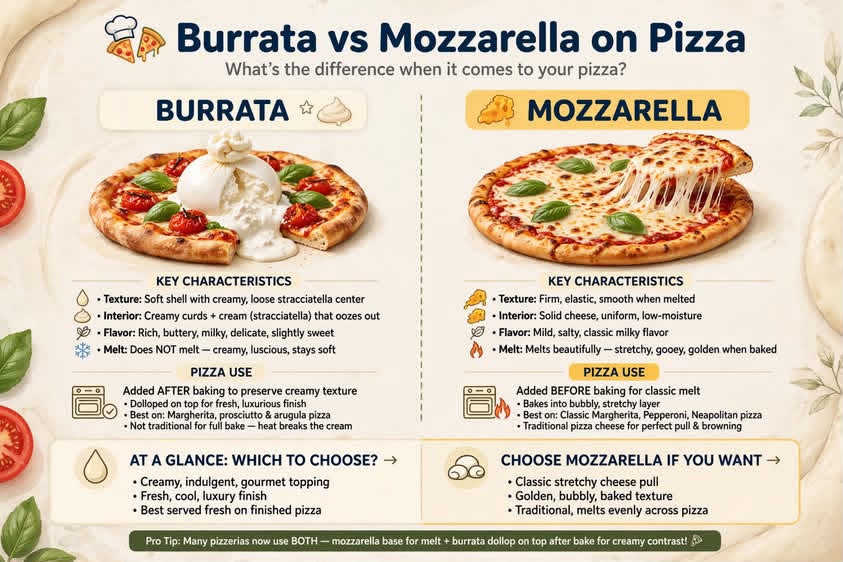
There is also a cost and texture conversation worth having here. Burrata is pricier than mozzarella almost everywhere I have shopped, and it does not keep as long once opened, since that cream filling spoils faster than a solid ball of mozzarella. If you are stocking a pizza kitchen for volume, mozzarella wins on practicality every single time. But if you are chasing flavor and texture over convenience, burrata brings something mozzarella simply cannot replicate, that rich, almost dessert-like creaminess against a crisp crust.
My honest take, after way too many test pizzas, is that these two cheeses are not really competitors. They are suited for different jobs. Mozzarella is the dependable foundation, the cheese you build a pizza around. Burrata is the finishing touch, the cheese you add once the hard work is already done. Next time you are debating burrata versus mozzarella for your pizza, maybe do not pick a side at all. Use mozzarella as your base layer, then finish with torn burrata right before serving. You get the melt and stretch people expect from a great pizza, plus that luxurious cream burrata is known for. That combination, at least in my kitchen, has become the real winner.
Reference
Bhoya, S., Dabhi, M., & Parmar, V. (2017). Functional properties of Mozzarella cheese for its end use application. Journal of Food Science and Technology, 54(12), 3766–3778. https://pubmed.ncbi.nlm.nih.gov/29085119/
Guinee, T. P., Zheng, M., & Auty, M. A. E. (2013). Physical properties of pizza Mozzarella cheese manufactured under different cheese‑making conditions. Journal of Dairy Science, 96(9), 5551–5563. https://www.journalofdairyscience.org/article/S0022-0302(13)00388-3/fulltext
Rudan, M. A., Barbano, D. M., Yun, J. J., & Kindstedt, P. S. (1998). Effect of fat reduction on chemical composition, proteolysis, functionality, and yield of Mozzarella cheese. Journal of Dairy Science, 81(8), 2064–2076. https://www.journalofdairyscience.org/article/S0022-0302(98)75812-6/pdf